Showing posts with label Cyclical Truths. Show all posts

Tuesday, 11 August 2020

Personal Discovery of Eco-Fiction, an Author’s Genre that Celebrates Our Relationships with Nature


Personal Discovery of Eco-Fiction, an Author’s Genre                   that Celebrates Nature's Relationships 


“As environmental crisis grows ever clearer, the best eco-fiction can help 

                           realign our conception of nature…”

It was a special discovery that finally answered my question what kind of e-books talk about water and trees as real characters with plots, problems and resolutions.

Eco-fiction is defined as nature literature based on the relationship between natural settings and human communities. It is a voice drawn from ecological principles that calls attention to act responsibly to be good ethical stewards of the Earth. There may be warnings of dangers to ignore it.

This special author's genre can help answer two questions:

  1. Can scientific facts be understood better through an imaginative creative license as an emotional, interactive first-person experience?
  2. Can the unique power in figurative language known as personification give human characteristics to non-living things or ideas to make better associations to better relate with a sense of empathy that it matters?

I can now proudly say that I wrote 2 e-books that can be classified as eco-fiction by combining 2 parts: the science of ecology with the art of story writing.

Part 1: Ecology is the scientific study of the distribution and abundance of living organisms and how the distribution and abundance are affected by interactions between the organisms and their environment including both nonliving and living factors

Part 2:  A story composition includes basic elements of believable memorable characters, immersive settings, suspenseful plot lines, goals and challenges with resolutions at the end.

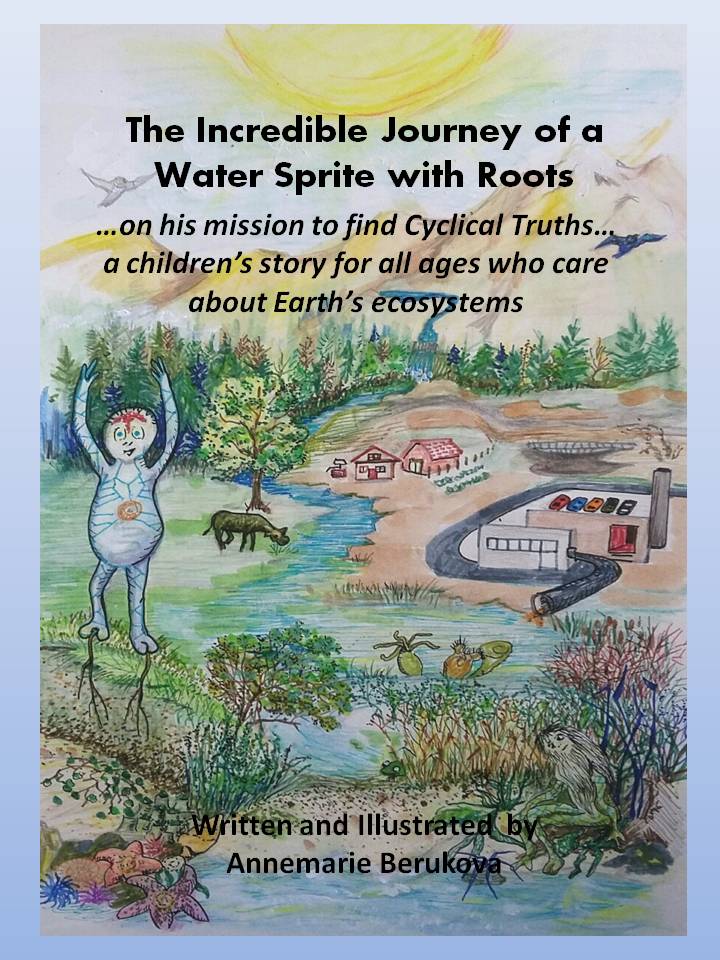
The Incredible Journey of a Water Sprite with Roots has the scientific basis of  the water cycle that describes the continuous movement of water as it makes a circuit from the oceans to the atmosphere to the Earth and back again.

The main character is a water sprite with roots who has natural affinity as a water resource and as a plant at the primary level in the ecosystem. He is a complex character existing in three states with a range of abilities, but the mystery is his mission to discover other Cyclical Truths as he returns to the ocean. Indeed, along the way, the suspense and amazement grow as to how many he will find and how they fit into interdependent ecosystems.

Indeed, he develops affection for a micro-organism, shares her pond’s education and experiences pollution at the micro level where it begins. A sub plot develops when he discovers a hydrocarbon molecule and is surprised at their mutual organic bonds for affecting climate change because they share carbon as well as hydrogen molecules. At the end, floating over the ocean he finds peace with his internal conflict  that in order to survive people need to balance and protect their ecosystems.  

Ecological Succession of Birchum Birch introduces a sensitive birch tree who undervalues his existence until a tree dryad inhabits him and her wisdom explains his functions and connections to his community. He lives through the value of seasons, why nature doesn’t produce garbage through the humus cycle, the interdependent food web, the variation of adaptations and seeds, and how a spider web can help to explain morality versus consumerism. He sees the ecological succession that happens after a forest fire and plays his own integral part in supporting his community as his legacy.

Ecological principles were the basis of both stories with a common theme that flourished about diversity and cooperation. The hostile antagonists were people who in short-sighted selfishness attacked or abused these principles. They didn’t understand that DNA starts in the nucleus of the smallest life-form and cycles through natural bio-systems, including the Earth's biosphere.    


In the end, the main question or challenge is how an eco-fiction story can help to change societal norms and beliefs about ecology, environment, and sustainability?


There are lessons to be learned from Nature's elements as real personalities. They can show  how to make the less visible more visible because the greatest law of Nature is we are all connected…if one part is missing, we all suffer.

How else can the water cycle come alive with surprise and mystery by a unique personality that deeply cares about his survival committed to common goals?

How else can a birch tree come alive with his curiosities, fears, flaws, strengths and affinity for his family home and community?

What’s more important than fresh water and a clean water cycle?

What’s more important than a tree to clean the air and combat climate change?

What amazing friends and true superheroes for children to know!


In fact, perhaps, the more we can understand the natural world from real participants, the more we can apply common experiences relative to both nature’s and people’s communities. In fact, don't we all need to adapt to changes in the environment and face common issues of how to manage connections, maintain diversity, broaden participation, and foster adaptive thinking…all ecological principles that require tolerance and patience?

 In the end, science and imagination synchronize and weave fascinating stories that only a water sprite with roots and a living tree can tell; that in order to survive, we need to balance our Earth’s ‘Cyclical Truths’  and protect its ecological ecosystems. 

Most importantly, the hope is for children of all ages to accompany and respect them in our natural environment even more around every chapter and care deeply for Nature's manners, fears and hopes.

Check out the e-books here.

Have you read this unique genre called eco-fiction? The question has been asked why more books aren't written to help explain Nature's point of view when in crisis. 

Comments are always appreciated.

Please note the series of podcast questions in these blogs... 


Annemarie

amarie10@gmail.com

833 471 4661 (leave a time to talk)

Who can better describe the microscopic food chain than a microorganism called Stentor as part of the Great Ecological Cycle?  He teaches the Water Sprite and his class, 

Excerpt: “This is one of the great Cyclical Truths … if one part lives, then the other part lives; if one part is destroyed then the other part will be destroyed in time? Isn't co-operation wonderful, a true democracy through diversity?"

PS:  Much more information about the evolution of Eco-fiction and examples of literary works can be found on dragonfly.org

Tuesday, 17 December 2019

Overview of Podcast Shows about Ecology's Cyclical Truths with this One-of-a-Kind Special Water Character


Overview of Podcast Shows about Ecology's Cyclical Truths with this One-and-Only Special Water Character


If you want your children to be intelligent, read them fairy tales. If you want them to be more intelligent, read them more fairy tales.”– Albert Einstein

Who doesn’t want to hold our beautiful blue planet in protective hands, symbolically? Who doesn’t like a walk in sunshine, breathe fresh air, feel a splatter of rain or eat a fresh salad, baked potato with chives-up sour cream and a cool glass of clean fresh water? That’s a nice package with a bow of gratitude, but how many parts are inside this package that need assembly to make sure that nature works as programmed? 

Bottom line, if we can’t negotiate with nature, then we better relate to the interdependent parts and functions; so we can pass Earth's priceless gifts to future generations. 

To that effect, a Facebook ad or video, does not do justice below the surface. I am looking for podcast shows interested in discussing important questions about ecosystems, natural cycles and how to resolve disruptive problems.

On one side, I believe that the audience may be amazed at the many functions of  a water cycle or ecosystems in general. I know I certainly am, learning so much through research; especially feeling, that an elementary knowledge of basic facts is not good enough to visualize the depth, co-dependence and intricacy of natural systems.

On the other side, why me as a podcast guest? You might think I lack expertise because I’m not a trained scientist with years of study. But I am a serious, respectful Earthling human being concerned enough to educate and protect our future within Earth's finite resources. Also, I am a retired teacher with an inborn DNA to value education and share more learning in an organized, open-ended way. 

To that motivation,  I wrote a one-of-a-kind e-book about a water sprite with roots based on scientific realities. Below, note the previous blogs that address ten possible podcast questions and answers.

Here are two more questions with references to the e-book and possible podcast shows.

Why does the water sprite hero have roots ... doesn’t this make him immobile?

Can scientific facts be understood better through an imaginative creative license as a first person experience?

First, it’s no wonder that dominant water forces have also played important roles in the realm of imagination, folklore and mythology. The theme of water becomes the flowchart by which people can explore, understand and integrate their cultural values based on living together whether philosophical, social or even ecological, constantly responding to change.
  • It’s very interesting to note the number of deities, named by the thousands in Greek and Roman mythology, who were ascribed powers to control the elements of all water. Their names were associated with seas, storms, waves, currents, sea-creatures, lakes, springs, rivers, fountains, marshes and ground waters. The most common was Poseidon as the king of the seas and lord of the sea-gods living in a golden palace on the seabed with his queen and son Triton who looked like a merman with the upper body of man and tail of a fish, calming the waves by blowing his conch shell horn.
  • Folklore from Western Native American tribes talked about water babies as mysterious and dangerous water spirits living in ponds and streams whose cries could signal distress or fore-warnings.
  • Modern aquatic superheroes display supernatural powers to champion a return to justice with extravagant cinematic powers that may momentarily dazzle without facts. 
But there has never been a character quite like this water sprite with roots. He is small, kind, sensitive, vulnerable as he is curious, speaks the language of Earth’s biological citizens. He personifies the total water cycle: he is the cloud, the dewdrop, the snowflake, the currents in a pond, the sap, the saliva, the solvent for synthetic pollutants. He is given the chance to pick his own name: Corddo-mont the Sixteen-Hundred-Billionth, the Variable, the Life-Giver, the Earth Sustainer or Cordd for short.

Why does the water sprite hero have roots ... doesn’t this make him immobile?

This water sprite is a highly specialized organism whose body composition is 96% pure water surrounded by two elastic cell layers, an inner one composed of cellulose and an outer one of protein fibers. Three characteristics:

  • his brain is found in his stomach where it can better regulate his complicated respiration; sometimes inhaling oxygen or carbon dioxide, depending on the role of plant or animal he  happens to be in. 
  • his heart is found in his head, directly connected to his eye spots so he can both see things and have feelings without others' observations and opinions. 
  • for protection, he has a typical encyst button like a belly button in his chest, which can shrink him into a state of dormancy until a more favorable time for re-emergence.
One unusual characteristic is that he can be classified as both animal and plant for two reasons:

  • first, he can also anchor himself into the ground by special root-retractors between his toes. Like any other root, he can absorb minerals from the soil and digest them as necessary vitamins, proteins and carbohydrates.
  • second, his outer cell layer contains chloroplasts cells which are visible like green freckles. Because these cells contain chlorophyll, he can directly convert the sunlight's energy into food energy, namely sugar, just like a plant can.
Most importantly, he can communicate with any other organic life form because they share carbon as well as hydrogen molecules.Therefore, he can express their stories, their dangers, imbalances, fears, and hopes from their realities about cyclical truths essential to ecology.    
Hopefully, people will feel a special bonding with this water character; thereby, making an emotional connection through his trials, tribulations and inclusions of all lives in a balanced natural environment. As the water sprite falls in love, so will the readers in kinship and motivational affinity to protect Nature at its best.

Can scientific facts be understood better through an imaginative creative license as a first person experience?


There is a unique power in figurative language known as personification when you can give human characteristics to non-living things or ideas. Associations help to better relate to the object or idea and have a sense of empathy that it matters. 

What more precious bonding can there be than to consider water as a valuable friend, as a person and necessity for survival? You wouldn't hurt or bully a good friend, right? 
  
Here are a  few situations where I feel personification helps to focus on water as a real entity in its own right for sustainability and protection:

  • how else can you describe evaporation from the ocean as frolicking with friendly air molecules, rising higher into snowstorms and freezing into a glacier?
  • how else can you describe the joy of a plant bathed in sunlight and drinking nutrients though it roots, feeling its body structure becoming stronger cell by cell?
  • what better way to show the family and community life of microorganisms, like rotifers, and their special bonding to fresh water except by developing mutual feelings of respect for each other?
  • who can better describe the microscopic food chain than a microorganism called Stentor as part of the Great Ecological Cycle?  He teaches his class, “This is one of the great Cyclical Truths … if one part lives, then the other part lives; if one part is destroyed then the other part will be destroyed in time? Isn't co-operation wonderful, a true democracy through diversity?"
  • how else can the horror of pollution be experienced except at a personal level and loss of a personal community with a forewarning of larger systems?
  • what better way to personify people as a block called humankinds which contains their inquiry, progress and power; however, the onus is left to the individual person to be responsible to make a difference outside the block?
In the end, science and imagination synchronize and weave a fascinating story that only a water sprite with roots can tell; that in order to survive, we need to balance our Earth’s ‘Cyclical Truths’  and protect its ecological ecosystems. Most importantly, the hope is for children of all ages can accompany him and respect our natural environment even more around every chapter. At the end, we should all  care deeply for his manners, fears and hopes. 

What an amazing friend especially for children to get to know!

Your questions, comments and referrals are always welcome.
What are some questions you wonder about the Earth's biology?
What are some solutions you think might help to fix imbalances?

Sincerely,
Annnemarie
amarie10@gmail.com
833 471 4661
https://helpfulmindstreamforchanges.com

This list outlines answers to previous questions:


BLOG:  Why is environmental sustainability based on biological diversity?
             What are some amazing Cyclical Truths discovered in a water cycle journey that                   may be less known?

BLOG:  What are the relationships between Earth’s biosphere, ecology, ecosystem and                     environment and us?
             What is the interesting relationship between a water molecule and a hydrocarbon?

BLOG:  How climate change disrupts the water cycle via the Hydro-logical Express - Cause               and Effect?   

BLOG:  How is pollution related to the water cycle...the worst pollutant of all

BLOG:  How does water teach us morality?  Does ecology have an ethical base?


              Cordd...the water sprite                             Roti...his best friend

Sunday, 15 December 2019

Questions about Ecology, Diversity, Sustainability Make for an Excellent Podcast Interview


Questions about Ecology, Diversity, Sustainability Make for an Excellent Podcast Interview

How is it possible that the most intellectual creature to ever walk the planet Earth is destroying its only home? – Jane Goodall

How would you define the effect of these important words on you and your family? Do they warrant more discussion about common environmental problems, denial of ecosystems, loss of species, too much waste pollution, material over-consumption, not to mention global warming.  

MISSION STATEMENT:  As a society, we must have an affinity for our finite planet and  must never diminish the Big Picture of survival in our limited biosphere without having a personal relationship to the diversity and symbiosis of all living and non-living things on Earth.

Ongoing research has opened new personal windows of understanding and appreciation. Nature ripples in her streams, languishes in her lakes, whispers in her wind, wavers fathoms deep into oceans, holds the baby bird, watches the green caterpillar on a cabbage leave, entertains families on a beach … and embraces the only life we have on Earth. But who will speak on behalf of Nature as a living, breathing entity unto herself for future generations? 

I look forward to podcast shows which may be interested in discussing ecology from Nature’s perspective. A previous blog outlined 10 questions with two given answers:

 Why is it important to know the similarity between biosphere. ecology, ecosystem and environment?

What is the interesting relationship between water molecule and a hydrocarbon?

Here are two more questions to answer on a podcast interview:

  1. Why is environmental sustainability based on biological diversity?
  2. What are some amazing Cyclical Truths discovered in a water cycle journey that may be less known?
1. Why is environmental sustainability based on biological diversity?

Every ecosystem has four parts or levels ... if one is missing, then the other parts will be unbalanced ... first rule of all ecosystems:
 1. Non living elements the sun, air, water  2. primary food producers 3. secondary consumers 4. decomposers to return the nutrients as well as release gases for breathing.
 
What is biodiversity: defined as all variety of living species of plants, animals, bacteria and fungi, and human beings. Their survival is based on their diversity, interactions and co-dependence in any given ecosystem to maintain balance and support life with food, clean water, medicine and shelter.

However, some reports (Global Assessment -2019 and WWF - 2018) have noted an average 60% decline in global population of mammals, fish, birds, reptiles and amphibians where many species may even face extinction. 
The reasons are population growth requiring one third of land mass and 75% fresh water for crops or livestock production.
Other human infractions are over fishing the ocean, clear cutting forests, depleting natural resources,  polluting our water and worsening a climate crisis. 

What is environmental sustainability? defined as maintaining and protecting biodiversity  that allows humans to satisfy their needs without exceeding the capacity of its supporting ecosystems to regenerate the services necessary to meet the long-term needs of future generations. 

We must realize as both individuals and corporate citizens, no matter how small or large, that we must help to maintain our environment with every positive action as part of a larger cycle. We can check out "green teams," improve eco-friendly supply chains, and reduce harmful or excessive waste. Our planet, society, and economy must sustain our future generations.
For example, if you cut down trees, make a plan to reforest. 
If you have a manufacturing factory, make sure your emissions are up to code.
If you run an industrialized agricultural operation, improve crop rotation, use less fertilizers or pesticides.


2. What are some of the less known but amazing Cyclical Truths discovered in a water cycle?

Each ecosystem has its own energy cycle which contains all of the living species and all non-living elements in any particular environment, whether as a single tree, a forest or even a puddle. This energy flows from the sun through plants, primary food producers, secondary consumers like animals and humans, and microorganisms which ends with decomposition in order to recycle the process again. 

In fact, numerous interdependent cycles are required for ecology to balance and sustain these many lifeforms and systems in an inclusive, cooperative biosphere. 
  • food chain starts with sun’s energy for producer organisms  (such as grass or trees) to make their own food, for consumers (such as animals and humans), to decomposing species. Energy and nutrients pass from one link to another.  For example, if you eat a hamburger for lunch, you are part of a food chain that started with grass to cow to human.
  • pesticide cycle are chemicals like insecticides, fungicides, or herbicides. They can be absorbed by insects, fish and other organisms, blow away to non-sprayed areas, flow with rain water into streams or seep through the soil into ground water and remain in the environment for years. Pesticides damage ecosystems by disrupting food chains as part of food webs, or decrease biodiversity through loss of populations, even cause extinction of species. Also note that the higher up in a food chain, the more concentration of chemicals at the top.  For example, from a grasshopper to a shrew to an owl who gets sick is called  bioamplification.
  • nitrogen cycle is the circulation of nitrogen in various forms through nature. Nitrogen is essential to life because it makes proteins and nucleic acids.  Most of the atmosphere is nitrogen gas, but this gas can only be used by plants and animals if first transformed by microbes called nitrogen fixation or nitrification.
  • carbon cycle is probably the most important cycle as explained in a previous blog about the relationship between a water molecule and a hydrocarbon. Bottom line ... if too much carbon dioxide is returned to the atmosphere, an imbalance of greenhouse gases will influence global warming.Just think, a tree will use 48 pounds of carbon dioxide in year and supply enough oxygen for up to 4 people daily.

And so, this special story about an incredible journey to discover Cyclical Truths was written to combine imagination, fantasy with scientific reality. The water sprite with roots is personified as a friend who experiences many encounters, imbalances, fears and hopes in his natural ecological journey. Because he shares an affinity with any organic life form derived from carbon and hydrogen, he can communicate with other beings and express their stories from their realities. Most importantly, he talks the walk through his mission of discovering cyclical truths from the sun to water to nutrients to plants to animals to decomposing bacteria to respecting the biodiversity essential for all life. 

Who do you know in the podcast sphere of influencers who may be interested in talking about our one and only blue planet, it's biodiversity and cry out for environmental  sustainability? Once again you can check out the other 10 questions for podcast interview on previous blog link above.

What questions do you have about our earth's biology and how to maintain and respect it?
What actions or changes do you see that may help or harm our future generations?

Sincerely,
Annemarie
amarie10@gmail.com
833 471 4661 (leave message and the best time to talk)
https://helpfulmindstreamforchanges.com
      Stentor stretches his long neck as long as he can.
"This is termed the food chain and it is part of the great ecological cycle.  This is one of the great Cyclical Truths … if one part lives, then the other part lives; if one part is destroyed then the other part will be destroyed in time.

Who gave Mother Nature such divine plans, how to look after even the smallest, to even the largest. Isn't ecology wonderful how it makes plants, animals and humankinds can stay living in co-operation? Isn't co-operation wonderful, a true democracy through diversity?"

Co-operation … co-operation … so many heads are now reciting the same word and thought.. 


Tuesday, 3 December 2019

Announcement: Special E-Book is Now Available on Kindle....What Do You Want to Know about The Water Sprite with Roots?


Announcement: Special E-Book is Now Available on Kindle...What Do You Want to Know about The Water Sprite with Roots? 


I wonder but I really don't know. I wonder if anybody knows, even humankinds who are probably too busy with no time to dig deeper into what the right connections can mean to us all. But I care. Is caring a cycle? If you care enough about something, is that caring returned to you? If responsibility is given or taken, is that responsibility respected and used well? Generally speaking, do humankinds believe in being responsible at least, if not appreciative, of how past, present and future actions are all connected?

I am pleased to announce the Kindle publication of my e-book, The Incredible Journey of a Water Sprite with Roots on his mission to discover Cyclical Truths for all ages who care about Earth's ecosystems.  

Here is the Kindle blurb:
There is nothing more powerful than creative writing which mixes science to express facts and feelings about our Earth’s ecology.  Welcome to a powerful credible first-person narrative about a living, feeling, talking water sprite with roots so you can share his experiences on his water cycle and discovery of several crucial natural cycles we may not talk about but cannot be taken for granted.  

His story combines imagination and fantasy with scientific reality.  Because he shares an affinity with any organic life form derived from carbon and hydrogen, he can communicate with other beings and express their stories from their realities. He empathizes with all habitats and inhabitants from microorganisms to hydrocarbons of all forms. He connects the dots between climate, pollution and food production.

He is a living, feeling, talking water drop who narrates his experiences in present tense as he discovers several important cycles to maintain a healthy ecosystem, a healthy biodiversity and a healthy humankind society. Most importantly, he helps to explain the Cyclical Truths that are very real and essential to the Earth's ecology as he embodies the words ‘sustainable development’ and ‘ethical consumerism.’

There can be no more precious bonding than to consider water as a valuable friend, as a person and necessity for survival? You wouldn't hurt or bully a good friend, right?

In the end, science and imagination weave a fascinating story that only a water sprite with roots can tell; that in order to survive, we need to balance our Earth’s Cyclical Truths  and protect the diversity found in ecological ecosystems from the smallest to the largest.

Most importantly, the hope is for children of all ages to accompany him and respect our natural environment even more around every chapter. At the end, we should all  care deeply for his manners, fears and hopes. 

What an amazing friend especially for children to get to know.

 
Check it out today ...read the first two chapters. Let me know what you think. 

Sincerely,
Annemarie 
amarie10@gmail.com
833 471 4661 (leave a message)
https://helpfulmindstreamforchanges.com


As well, I am always interested in podcast interviews to discuss our Earth's ecology, problems and solutions. Our footprints matter. 
See list of 12 questions...two have been answered.


Sunday, 31 March 2019

Arrival Announcement of Personal Website: 3 Matters that Make a Difference


Arrival Announcement: Personal Website Considers 3 Matters that Make a Difference


The path of awakening is not about becoming who you are. Rather it is about unbecoming who you are not. Albert Schweitzer

Like any proud parent, I wish to announce the arrival of my completed personal website.

It has taken 70 years to give it birth, much experience, contemplation and finally a legacy to leave the world as such. I'm sure we can all relate to the levels of wisdom we can accumulate with age; but I have three matters about which I feel strongly enough to try and make a difference on this world wide stage.
ONLINE BUSINESS CHANGES
TIMELY SOLUTION FOR TEEN GIRLS
WATER ECOSYSTEM FOR CHILDREN

ONE: 
...the exponential growth of the Digital Economy, the dramatic changes in the internet marketing industry within the last ten years and how more marketers can take greater advantage.  

Question: Along the way, if it is undeniable  that  internet marketing has simplified and compounded, then how can regular marketers and business owners adapt to changes and compete fairly with marketing powerhouses?
Answer: Get a different insight to avoid the earlier common marketing blunders and how to stay competitive through Business Leverage and the Power of You as an online core identity. There are two reports to check out called How to Start to Grow a Profitable Online Business and The Self-Franchise Report. The recommended program is based on a tour to try the benefits of a total marketing system, a one-stop-shop  for tools, resources and assistance every online business owner needs

Excerpt (The Self-Franchise Report): There is always need for new tools that give direction and resources for success in the digital marketplace for every person with or without technical skills with no critical details missing. In fact, if you have a plan or a tool to help the masses how to market...fortunes will be made by helping so many others.

TWO
...the internet has also hugely changed our culture with important memes that are part of any culture; our jobs, our families, social relationships, lifestyles, goals and world views. Along the way, young teenage girls with their cell phones and Selfies have openly participated in assuming adult roles as portrayed in the Social Media Circus with many kinds of negative results.  

Question: Is there a way to show teenage girls that their adolescent brains may have been hacked causing problems and regrets with Selfie addiction, with a discussion about the importance of respecting their timelines?

Answer:  A new e-book called A Teen Girl Faces Time in the Sand ...A Timely Tale of Social Media struggles, Regrets and Survival with a Super-Power Tool. The key question is asked in chapter one, "What if, you had the power to see the future and how your actions today may affect it? Would you make the same choices today?"

And so, this story is told of a young adolescent girl's struggles in a hyper media environment, the realization of her rash and brash  brain, her descent into drug addiction, her nightmares of media control, and her gradual awareness of the transient TIME measured not by numbers, counting hours or days, but with blocks and circles of experience as first drawn in the sand and explained by her Grannie.

Excerpt"BUT time is only the medium not the victim here.  A 14 year old girl can become a victim because she can make a mistake that will affect her whole life. How fair is that?  Is it her fault or is it the selfish culture around her? There must be an answer how to stop making the wrong choice at a young age."

THREE:  
...more recently, with greater alarm, the world is paying more attention to the Earth's bio-systems, ecological balance, pollution and climate change in particular.

Question:  How can we show young people that ecological systems are related and depended on each other from the smallest micro-organisms to plants, animals, air, water and even hydrocarbons where humans play a deciding role in survival at all levels? 

Answer: New e-book called The Incredible Journey of a Water Sprite with Roots...on his mission to find Cyclical Truths ...a children's story for all ages who care about the Earths ecosystem
This unique water sprite with plant features is often amazed with his encounters with different characters, some imaginary, but in real settings; and how many life forms and systems are interdependent where one broken link can affect the whole system. He can communicate with other beings because of a shared affinity with any organic life form of which there is a great quantity derived from our carbon based planet. The story is first person narration to personify the water sprite as a friend we should all care about his manners, fears and hopes and the essential cyclical truths he discovers.
Excerpt
My thoughts wander about the kind of ecology that humankinds believe in, as I have witnessed. Do they get it that natural life begins with DNA in a nucleus, one celled animals and plants, then species and then an ecosystem? Do they know that every small ecosystem is part of the total large biosphere on Earth that connects them all; water, air, food, resources, and shelter? Do they realize that perpetual growth, industry or destruction of any habitat is not sustainable on a limited planet?
to download by the end of next week.

New e-books will be available to download by the end of this week at this website.

Comments and questions as always are welcome,
Annemarie


Where to Discover Responsible Skin Care with added Direct Bonuses

 Rediscover your Skin’s Potential for Natural Beauty from Within Skin Care certainly should not be a monolithic profit machine for mass adve...