Showing posts with label water molecule. Show all posts

Tuesday, 11 August 2020

Personal Discovery of Eco-Fiction, an Author’s Genre that Celebrates Our Relationships with Nature


Personal Discovery of Eco-Fiction, an Author’s Genre                   that Celebrates Nature's Relationships 


“As environmental crisis grows ever clearer, the best eco-fiction can help 

                           realign our conception of nature…”

It was a special discovery that finally answered my question what kind of e-books talk about water and trees as real characters with plots, problems and resolutions.

Eco-fiction is defined as nature literature based on the relationship between natural settings and human communities. It is a voice drawn from ecological principles that calls attention to act responsibly to be good ethical stewards of the Earth. There may be warnings of dangers to ignore it.

This special author's genre can help answer two questions:

  1. Can scientific facts be understood better through an imaginative creative license as an emotional, interactive first-person experience?
  2. Can the unique power in figurative language known as personification give human characteristics to non-living things or ideas to make better associations to better relate with a sense of empathy that it matters?

I can now proudly say that I wrote 2 e-books that can be classified as eco-fiction by combining 2 parts: the science of ecology with the art of story writing.

Part 1: Ecology is the scientific study of the distribution and abundance of living organisms and how the distribution and abundance are affected by interactions between the organisms and their environment including both nonliving and living factors

Part 2:  A story composition includes basic elements of believable memorable characters, immersive settings, suspenseful plot lines, goals and challenges with resolutions at the end.

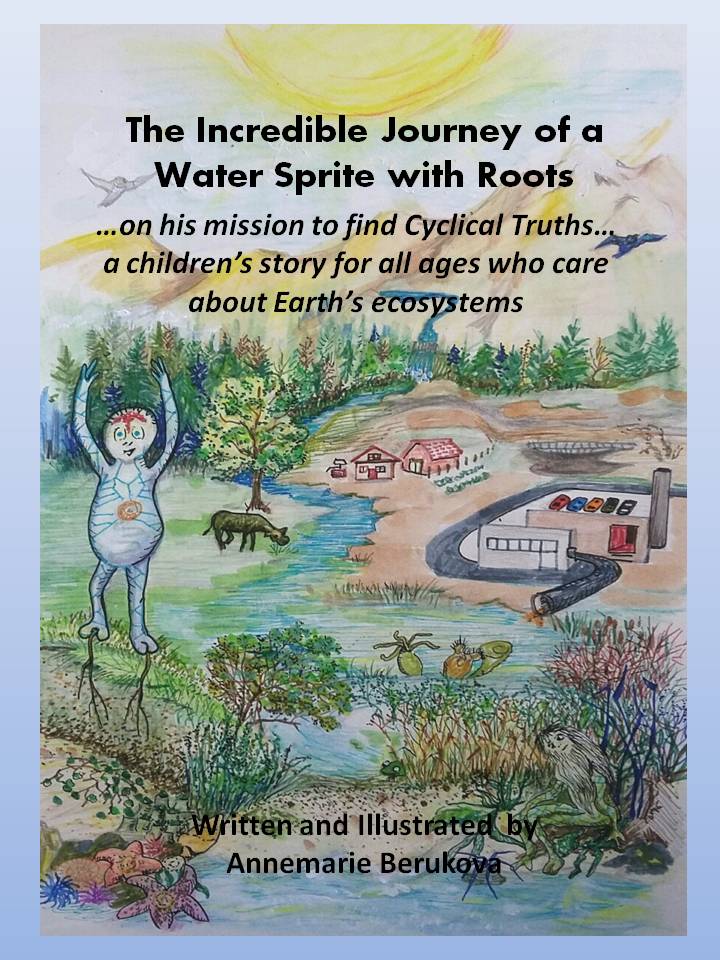
The Incredible Journey of a Water Sprite with Roots has the scientific basis of  the water cycle that describes the continuous movement of water as it makes a circuit from the oceans to the atmosphere to the Earth and back again.

The main character is a water sprite with roots who has natural affinity as a water resource and as a plant at the primary level in the ecosystem. He is a complex character existing in three states with a range of abilities, but the mystery is his mission to discover other Cyclical Truths as he returns to the ocean. Indeed, along the way, the suspense and amazement grow as to how many he will find and how they fit into interdependent ecosystems.

Indeed, he develops affection for a micro-organism, shares her pond’s education and experiences pollution at the micro level where it begins. A sub plot develops when he discovers a hydrocarbon molecule and is surprised at their mutual organic bonds for affecting climate change because they share carbon as well as hydrogen molecules. At the end, floating over the ocean he finds peace with his internal conflict  that in order to survive people need to balance and protect their ecosystems.  

Ecological Succession of Birchum Birch introduces a sensitive birch tree who undervalues his existence until a tree dryad inhabits him and her wisdom explains his functions and connections to his community. He lives through the value of seasons, why nature doesn’t produce garbage through the humus cycle, the interdependent food web, the variation of adaptations and seeds, and how a spider web can help to explain morality versus consumerism. He sees the ecological succession that happens after a forest fire and plays his own integral part in supporting his community as his legacy.

Ecological principles were the basis of both stories with a common theme that flourished about diversity and cooperation. The hostile antagonists were people who in short-sighted selfishness attacked or abused these principles. They didn’t understand that DNA starts in the nucleus of the smallest life-form and cycles through natural bio-systems, including the Earth's biosphere.    


In the end, the main question or challenge is how an eco-fiction story can help to change societal norms and beliefs about ecology, environment, and sustainability?


There are lessons to be learned from Nature's elements as real personalities. They can show  how to make the less visible more visible because the greatest law of Nature is we are all connected…if one part is missing, we all suffer.

How else can the water cycle come alive with surprise and mystery by a unique personality that deeply cares about his survival committed to common goals?

How else can a birch tree come alive with his curiosities, fears, flaws, strengths and affinity for his family home and community?

What’s more important than fresh water and a clean water cycle?

What’s more important than a tree to clean the air and combat climate change?

What amazing friends and true superheroes for children to know!


In fact, perhaps, the more we can understand the natural world from real participants, the more we can apply common experiences relative to both nature’s and people’s communities. In fact, don't we all need to adapt to changes in the environment and face common issues of how to manage connections, maintain diversity, broaden participation, and foster adaptive thinking…all ecological principles that require tolerance and patience?

 In the end, science and imagination synchronize and weave fascinating stories that only a water sprite with roots and a living tree can tell; that in order to survive, we need to balance our Earth’s ‘Cyclical Truths’  and protect its ecological ecosystems. 

Most importantly, the hope is for children of all ages to accompany and respect them in our natural environment even more around every chapter and care deeply for Nature's manners, fears and hopes.

Check out the e-books here.

Have you read this unique genre called eco-fiction? The question has been asked why more books aren't written to help explain Nature's point of view when in crisis. 

Comments are always appreciated.

Please note the series of podcast questions in these blogs... 


Annemarie

amarie10@gmail.com

833 471 4661 (leave a time to talk)

Who can better describe the microscopic food chain than a microorganism called Stentor as part of the Great Ecological Cycle?  He teaches the Water Sprite and his class, 

Excerpt: “This is one of the great Cyclical Truths … if one part lives, then the other part lives; if one part is destroyed then the other part will be destroyed in time? Isn't co-operation wonderful, a true democracy through diversity?"

PS:  Much more information about the evolution of Eco-fiction and examples of literary works can be found on dragonfly.org

Thursday, 22 August 2019

Do You Really Understand How the Five Essential Facts about Water are Ethical?


Do You Really Understand How Five Essential Facts about Water are Ethical?


Water, water, everywhere, 
And all the boards did shrink; 
Water, water, everywhere, 
Nor any drop to drink.” ― 
Samuel Taylor Coleridge, The Rime of the Ancient Mariner  


Water is everywhere…in the seas and oceans, groundwater or aquifers, polar ice caps,  lakes and streams, atmospheric moisture, locked within the bodies of living things. It is a transparent, tasteless and odorless chemical substance without which Life on the earth would not be possible and, therefore, must be protected with ethical responsibility by every person.

The more we can learn about water, the more precious and inviolable it becomes. Here are some interesting facts, some which you may commonly know and some which may open a greater awareness of water’s importance as they did for me.

Fact 1 - CYCLE: Water moves around the earth in a water cycle with 5 parts: evaporation, condensation, precipitation, infiltration and surface run-off.  Water helps to regulate the earth's temperature.

In a 100-year period, a water molecule spends 98 years in the ocean, 20 months as ice, about 2 weeks in lakes and rivers, and less than a week in the atmosphere. Groundwater can take a human lifetime just to travel a mile.

The overall amount of water on our planet has recycled to remain the same for two billion years. There is the same amount of water on earth as there was when the earth was formed. The water that comes from your faucet could well contain molecules that dinosaurs drank.

Fact 2 - QUANTITY:  Earth is largely water at 75% with 25% for land mass. Apparently 97% of the total amount of water on earth is found in oceans, 2% of which is frozen. It doesn't take much salt to make water "salty." If one-thousandth (or more) of the weight of water is from salt, then the water is "saline."  Saline water can be desalinated for use as drinking water by going through a process to remove the salt from the water.

Of all the water on earth, only 2.5% is fresh water. Less than 1% of the water supply on earth can be used as drinking water to be used by a huge population all over the world dependent for their survival.

Fact 3 - FORMULA:  Water is the only substance that is found naturally on Earth in three forms: liquid, gas, or solid depending on how far apart the molecules are…densest in ice, farthest apart in gas. Water freezes at zero degrees Celsius and vaporizes at a hundred degrees Celsius.

The water molecule consists of three air atoms, 2 Hydrogen atoms and an Oxygen atom that are bond together due to electrical charges. Weight of a water molecule depends on the number of molecules present; one molecule is 18 grams. A liter of water weighs about 2 pounds (1.01 kilograms).

Fact 4 - HUMANITY:  Clean pure water is essential to humans. Approximately 66% of the human body consists of water including all organs as they perform their physical functions.  The total amount of water in the body of an average adult is 37 liters. Human brains are 75% water.  Human bones are 25% water.  Human blood is 83% water.

A person must consume 2 liters (8 glasses) of water daily to live healthily. You can live about a month without food, but only about a week without water. If a human does not absorb enough water, dehydration is the result. Humans can drink an average of 75,000 liters of water throughout their   lifetime.

Humans use about 190 liters or 50 gallons of water every day.  An automatic dishwasher uses 9 to 12 gallons of water. A small drip from a faucet can waste as much as 75 liters of water a day. 

Two thirds of the water used in a home is used in the bathroom. To flush a toilet we use 2 to 7 gallons of water. A five-minute shower takes about 25 to 50 gallons of water. Brushing your teeth can use 2 gallons of water unless you fill a glass to rinse your teeth instead of running the tap.

You should never drink water straight from a lake or river, as it can cause serious health damage if it is contaminated by bacteria and other micro-organisms. In most cities and towns, drinking water from the tap is treated so that people don't get sick with diseases such as cholera and typhoid, which are caused by bacteria, viruses or parasites found naturally in the water.

Bottled water can be up to 1000 times more expensive than tap water and it may not be as safe. Besides, there is the unsustainable problem of thrashing the plastic bottle and polluting without biodegrading. 

Unfortunately, more than 2 billion people on earth do not have a safe supply of water. Today, at least 400 million people live in regions with severe water shortages.  Most of the world's people must walk at least 3 hours to fetch water. Each day almost 10,000 children under the age of 5 in Third World countries die as a result of illnesses contracted by use of impure water.

Fact 5 - POLLUTION:  Because water molecules have both polar and adhesive properties, they are attracted to other molecules as a simple access to water pollution. Water quality is affected because humans dispose of their waste in water and because industrial uses add all kinds of substances and contaminants that are not naturally present. There are at least 70,000 water pollutants with more than 500 new chemicals are developed each year. For example, 1 gallon of gasoline can contaminate approximately 750,000 gallons of water.

Public water supplies must consistently supply water to cities requiring over a hundred different standards for drinking water quality including lead free pipes as a minimum standard to start with.

Oceans and coastal areas are especially impacted because of more concentrations of pollutants from normal water sheds and run-offs.

How about this interesting fact?  A chicken is 75% water and takes 120 gallons of water to produce one egg.
What about this fact:  It takes 1,850 gallons of water to refine one barrel of crude oil. Any kind of industrial use also hugely impacts our supply of fresh water.

So next time you feel a raindrop on your nose, or take a swallow of cool clean water, pay attention to the myriad of links to this most precious life-sustaining commodity resource we have. In fact, a few lifestyle changes can help to preserve your own personal use of water: such as, keep taps from over rinsing, use water efficient appliances, wash with phosphate free detergents and clean with nontoxic biodegradable household products.

Take time to watch water trickle through your fingers. This is where life comes from. It seems without form but can split the hardest rocks over time and reshape the geology, habitats and communities with floods and droughts.  No one living plant or creature can live without it. Strange to think that human beings are frail and small in comparison but are largely in the control of the taps and its utilization. 

Yes, the more we know, the more we need to manage water from a sense of accommodating to its cycles and truths rather than controlling its powers for selfish agendas. Yes, we are totally, deeply dependent on the bounty of this natural cycle and each one of us has the responsibility to respect and protect our planetary shared precious water.


PS: It gives me great pride to be the author of a special e-book called The Incredible Journey of a Water Sprite with Roots on his mission to discover Cyclical Truths … 

Imagine for a moment that there is a character who personifies this most valuable, but limited resource, known as pure, fresh water. He is unique because he is also part plant with retractable roots and cellular chloroplasts with which to make his own food from the sun's energy.  This gives him a unique perspective on the symbiotic interdependence among plants, animals and even micro-organisms at the four important levels of healthy ecosystems.

Read more about the introduction  how and why this story was written 


Read more about the Most Common Questions about the Incredible Journey of The Water Sprite with Plant Roots and a Table of Contents
   

Excerpt: My thoughts wander about the kind of ecology that humankinds believe in, as I have witnessed. Do they get it that natural life begins with DNA in a nucleus, one celled animals and plants, then species and then an ecosystem? Do they know that every small ecosystem is part of the total large biosphere on Earth that connects them all; water, air, food, resources, and shelter? Do they realize that perpetual growth, industry or destruction of any habitat is not sustainable on a limited planet?

Download here: 50% of profits is shared with water conservation agencies and more.


How to Sell Yourself — Easy to Share, Learn and Help Solve Network Marketing Sales

People Like to Buy; They Don’t Like to be Sold To.   I don’t know how you may feel about the tension between selling and buying as an invers...